
 EN

Understanding Kitchen Ventilation Challenges in Modern Living Spaces
Walking into a kitchen hours after dinner preparation and still smelling seared garlic or frying oil signals an inadequate air purification setup. Cooking generates airborne grease droplets, steam, smoke, and thermal plumes that settle on cabinetry and furniture if not captured immediately at the source. Selecting the appropriate range hood determines whether a culinary space remains fresh and inviting or becomes a trap for lingering odors and sticky residues. Property developers, interior contractors, and homeowners constantly weigh the functional trade-offs between ducted extraction architectures and ductless recirculating configurations. Each ventilation pathway addresses distinct structural realities, cooking habits, and architectural constraints across residential apartments, luxury villas, and hospitality suites. Understanding how air moves through a kitchen environment lays the groundwork for choosing an extraction system that balances acoustic comfort, visual harmony, and filtration power.
How Ducted Extraction Works for Heavy Culinary Demands
A ducted range hood operates on direct physical expulsion, pulling contaminated air upward from the cooktop and channeling it through concealed rigid or flexible ductwork directly outside the building envelope. For households and commercial suites that frequently engage in high-heat searing, wok stir-frying, or multi-burner gas cooking, external venting delivers unmatched clearing capacity. High-performance wall-mounted units, such as a curved glass range hood or a sleek European T-shape model, combine high-airflow motors with quiet operation to clear dense cooking vapors rapidly. As rising plumes of steam and aerosolized oil hit the canopy, a durable multi-layer aluminum filter captures heavy grease particles before the air reaches the internal centrifugal blower. Because heat, moisture, and combustion byproducts exit the room entirely, a ducted range hood prevents indoor humidity spikes and keeps ambient room temperatures comfortable during intense meal preparation. Constructed with easy-clean stainless steel builds and tempered glass canopies, these vented appliances serve as both heavy-duty air purifiers and striking visual anchors on the kitchen wall.
Inside Ductless Recirculating Filtration Technology
Architectural blueprints do not always permit cutting holes through exterior load-bearing walls or running exhaust pipes across concrete ceilings. High-rise urban apartments, heritage building renovations, and modular studio kitchens frequently rely on a ductless recirculating range hood to maintain clean indoor air without structural ducting. Instead of venting outdoors, a recirculating kitchen exhaust fan draws cooking fumes through a dual-stage internal purification matrix and releases the treated air back into the room. The primary layer utilizes a removable metallic mesh or aluminum filter to trap airborne cooking oils and solid particulates. Next, the airflow passes through activated charcoal filters engineered to adsorb odor molecules and volatile organic compounds. A space-saving slim range hood or a telescopic under-cabinet cooker hood fits seamlessly beneath existing overhead cupboards, preserving valuable vertical storage space while delivering dependable odor neutralization. While a recirculating range hood returns heat and moisture to the room, pairing it with electric or induction cooktops creates an exceptionally clean, easy-to-install culinary workstation.
Comparing Airflow Efficiency and Indoor Air Quality Standards
Environmental engineering benchmarks, including residential ventilation guidelines established by the American Society of Heating, Refrigerating and Air-Conditioning Engineers, emphasize source capture as the most effective defense against indoor air pollution. When evaluating a ducted versus a ductless range hood, airflow dynamics and static pressure resistance play central roles. Ducted installations experience minimal internal restriction when paired with short, smooth duct runs, allowing the high-airflow motor to operate at peak extraction efficiency with quiet acoustic output. Conversely, dense carbon media inside a ductless range hood introduces slight airflow resistance, requiring precision-balanced fan blades to keep operational noise low while maintaining steady suction across the cooking zone. Modern ventilation engineering bridges this gap by integrating aerodynamic housing contours, responsive touch or push-button control panels, and energy-saving LED lighting across both vented and recirculating designs. Whether installing a side-suction range hood close to the burner grates or a classic pyramid canopy, proper capture velocity ensures smoke never escapes into adjacent living areas.
Matching Kitchen Layouts with the Right Ventilation Architecture
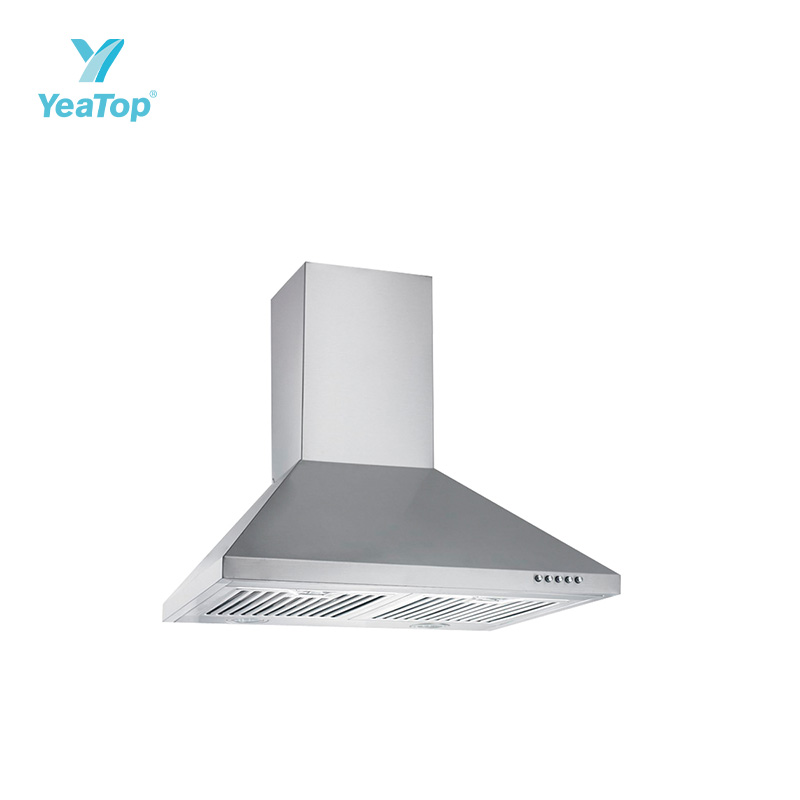
Real-world kitchen design requires aligning appliance form factors with room geometry and utility access. In expansive open-concept homes featuring a central cooking peninsula, a ceiling-mounted island range hood acts as a dramatic centerpiece that captures rising vapors from all four sides. When ceiling joists allow direct routing to the roof or exterior wall, ducted island configurations provide effortless clearing for large family gatherings. In compact urban flats or rental properties where cabinet space is at a premium, an under-cabinet or telescopic range hood configured for ductless recirculation eliminates complex contractor work and lowers installation expenses. Traditional and transitional interiors often favor a classic pyramid range hood that blends timeless geometric styling with durable stainless steel or matte black finishes, whereas contemporary culinary spaces gravitate toward tempered glass T-shape or angled side-suction range hood designs for wider coverage over multi-burner gas hobs. Selecting convertible models that support both vented and recirculating modes gives property owners the flexibility to adapt if renovation plans evolve in the future.
Evaluating Long Term Maintenance and Energy Consumption
Total cost of ownership extends well beyond initial appliance purchase and mounting hardware. Maintaining consistent suction performance in any range hood depends on disciplined filter care. Both ducted and ductless units feature easy-to-clean aluminum grease filters that can be detached in seconds and washed with warm soapy water or placed inside a residential dishwasher. Neglecting grease accumulation restricts airflow and forces the motor to work harder. For a ductless range hood, ongoing maintenance also includes replacing the non-washable activated charcoal filters every three to six months depending on cooking frequency, ensuring odor absorption remains crisp and effective. Ducted systems require occasional inspection of exterior wall dampers and duct interiors every few years to verify clear passage. Equipped with high-efficiency low-noise motors and long-lasting LED illumination, a modern range hood consumes minimal electricity during daily meal preparation while protecting surrounding cabinetry from costly grease degradation and paint discoloration.
Sourcing Reliable Ventilation Appliances for Global Markets
Behind every quiet, high-suction kitchen ventilation system stands rigorous manufacturing engineering and supply chain coordination. For appliance distributors, residential project contractors, and private-label kitchenware brands, partnering with a seasoned manufacturer ensures product consistency across diverse regional markets. Operating from Guangdong, China since 2005, Jiaye Group specializes in designing and producing certified home appliances tailored for global export. From space-saving slim profiles and telescopic under-cabinet units to high-airflow curved glass, pyramid, T-shaped, side-suction, and island models, every range hood undergoes strict quality testing for motor longevity, acoustic balance, and structural safety. Jiaye supports bespoke OEM and ODM brand customization through flexible low minimum order quantities, offering tailored sizes, airflow capacities, voltage standards, plug types, custom logos, and adaptable filter configurations for both ducted and recirculating applications. By integrating streamlined production lines with comprehensive one-stop sourcing for gas hobs, induction cookers, built-in ovens, and dishwashers, Jiaye Group empowers global partners to deliver healthy, stylish, and high-performing kitchen environments to households worldwide.
Frequently Asked Questions About Kitchen Ventilation Systems
Can a ducted range hood be converted to a ductless recirculating system?
Many modern wall-mounted, slim, and curved glass models are engineered as convertible appliances. By attaching compatible activated carbon filters to the motor housing and adjusting the internal air diverter, a convertible range hood can operate in recirculating mode when exterior ducting is unavailable.
How often should filters be cleaned or replaced in a range hood?
Metallic aluminum grease filters in both ducted and ductless systems should be washed every three to four weeks under regular cooking conditions to maintain optimal airflow. In a ductless range hood, the activated charcoal filters cannot be washed and should be replaced every three to six months.
How should the width of a range hood match the cooktop below it?
The canopy width of a range hood should at least span the full width of the cooking surface below it. Compact under-cabinet or slim models pair ideally with standard two-burner to four-burner cooktops, while wider T-shape, curved glass, or island canopies provide full capture coverage for large multi-burner gas hobs.
Does a ductless range hood remove heat and steam from the kitchen?
A ductless recirculating range hood excels at trapping airborne grease droplets and neutralizing cooking odors through aluminum and carbon filtration, but it circulates warm air and moisture back into the room rather than venting them outside.
What features are recommended for heavy frying and frequent gas cooking?
For frequent high-heat cooking or multi-burner gas stoves, selecting a ducted range hood equipped with a high-airflow motor, multi-layer aluminum grease filters, and a deep capture canopy ensures rapid clearing of dense smoke, steam, and combustion fumes.
Table of Contents
- Understanding Kitchen Ventilation Challenges in Modern Living Spaces
- How Ducted Extraction Works for Heavy Culinary Demands
- Inside Ductless Recirculating Filtration Technology
- Comparing Airflow Efficiency and Indoor Air Quality Standards
- Matching Kitchen Layouts with the Right Ventilation Architecture
- Evaluating Long Term Maintenance and Energy Consumption
- Sourcing Reliable Ventilation Appliances for Global Markets
- Frequently Asked Questions About Kitchen Ventilation Systems